How Did the Market Perform This Past Quarter?
Equity Market Overview
Through the first quarter of 2026, we saw a decline across the three main equity markets: US Stocks, International Developed Stocks, and Emerging Market Stocks. It was a volatile quarter driven by several crosscurrents — most notably the outbreak of conflict in the Middle East, which rattled investor confidence and sent energy prices sharply higher. US large-cap stocks bore the brunt of the selloff, falling roughly 4% for the quarter, while International Developed stocks declined about 1% and Emerging Market stocks were essentially flat, down just 0.17%
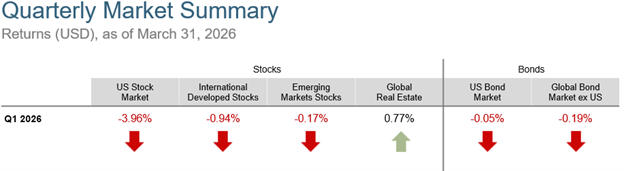
Looking back over the past year, the stock market rewarded investors who stayed globally diversified. In 2025, International equities gained ~23% and Emerging Market equities gained roughly 30% for the year, significantly outperforming US stocks. International stocks outperformed US stocks by more than 5% in 2025 and Emerging Stocks outperformed the US ~12%.
Many investors came into 2026 still underweight international and emerging markets, meaning most did not fully benefit from that strong performance. For those who were properly diversified, it made a real difference.

Fixed Income
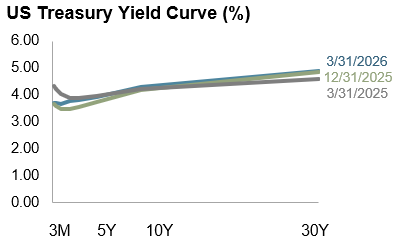
Year to date, interest rates have increased unfortunately for home buyers and those looking to refinance. However, interest rates remain flat overall. On the short end of the yield curve, the 1-Month US Treasury Bill yield remained unchanged at 3.74%. The 1-Year US Treasury Bill yield increased 20 basis points (bps) to 3.68%. The yield on the 2-Year US Treasury Note increased 32 bps to 3.79%.
The yield on the 5-Year US Treasury Note increased 19 bps to 3.92%. The yield on the 10-Year US Treasury Note increased 12 bps to 4.30%. The yield on the 30-Year US Treasury Bond increased 4 bps to 4.88%.
Geopolitical Risk
Wars such as the one unfolding in Iran are always disturbing. For investors, there’s additional concern over whether these conflicts will spill over into their investment performance. But it’s important for investors to be cautious about making asset allocation changes in response to such events.
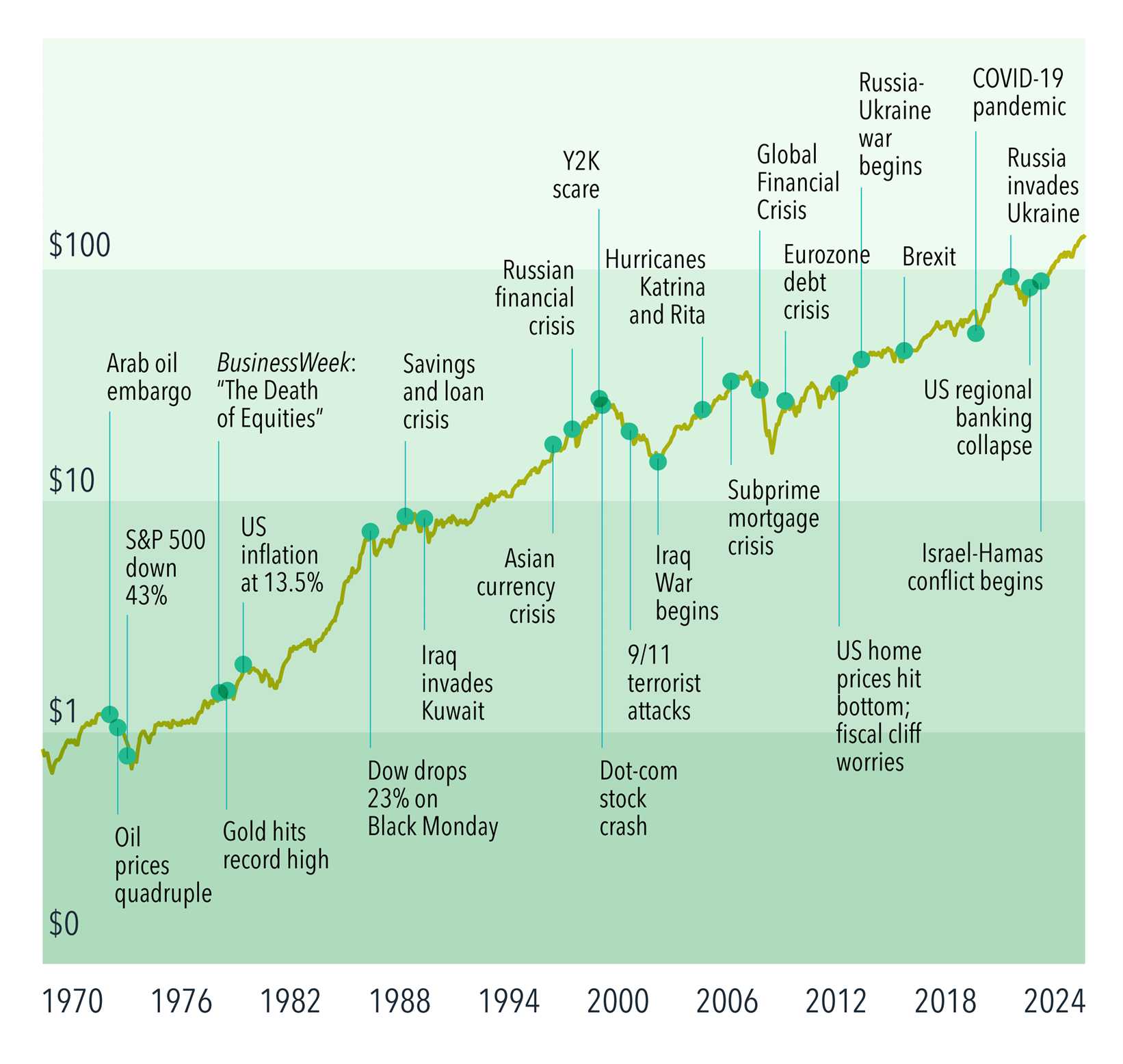
Markets are forward-looking. Prices move in response to changes in information. When unexpected developments arise that investors deem to be poor for markets, markets often drop. But the flip side is markets always set prices for positive expected returns. Once the news gets reflected in market prices, investors can still expect positive returns even amid worrisome circumstances.
This is borne out in historical stock returns. Global equity markets have continued an upward climb even in the face of economic and political upheavals. We don’t have to look far for illustrative examples. During the past few years, stock markets have had positive returns despite multiple wars being fought around the world.
This is not to trivialize the destruction wars bring and their impact on geopolitical risks. But history suggests investors may not help themselves by divesting from stocks. For long-term investors, the best bet is usually to stay the course.
Markets Reward Discipline