
Are You a High-Income Earner Contributing to a Traditional IRA? Make Sure You Don't Make This Costly Mistake.
Many high-income professionals make sound financial decisions, but one of the most common retirement planning mistakes we see is contributing to a Traditional IRA without realizing they don’t qualify for the tax deduction.
While this may seem like a small oversight, it can create unnecessary tax complications, improper tax filings, and potentially lead to paying double taxes if not handled correctly.
In this article, we'll answer several common questions:
• Can I deduct my Traditional IRA contribution?
• What are the Traditional IRA deduction income limits?
• What is IRS Form 8606?
• What is a non-deductible Traditional IRA contribution?
• How can I avoid paying tax twice on the same IRA contribution?
Can I Always Deduct My Traditional IRA Contribution?
The short answer is no.
One of the biggest benefits of contributing to a Traditional IRA is the potential tax deduction. For example, if you earn $100,000 and make a deductible $7,500 Traditional IRA contribution, your taxable income would be reduced to $92,500, potentially lowering your federal and state income taxes.
However, not everyone qualifies for this deduction. *For this article and data information set, we are only focusing on those high-earning professionals covered by a plan at work*
If you (or your spouse) are covered by a retirement plan at work, such as a 401(k), the IRS phases out and eventually eliminates the deduction once your income exceeds certain limits.
For 2026, below are the IRA Deduction Limits per Fidelity:
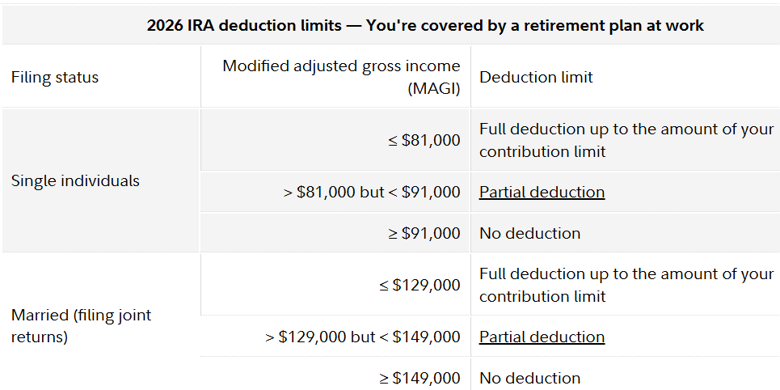
Because these income limits are adjusted periodically by the IRS, it's important to verify the current year's limits before making your contribution.
What Happens If I'm Over the Income Limit?
This is where many high-income earners unknowingly make a mistake.
If your income is too high to deduct your Traditional IRA contribution, you can still contribute to a Traditional IRA as long as you're otherwise eligible, but your contribution becomes a non-deductible IRA contribution.
In other words:
• You contribute after-tax dollars.
• You do not receive a tax deduction for the contribution.
• You should report those after-tax contributions on IRS Form 8606.
Unfortunately, many investors and even some tax preparers fail to file Form 8606.
What Is Form 8606?
IRS Form 8606 is used to report your non-deductible Traditional IRA contributions.
The form establishes what's called your basis in your Traditional IRA. Your basis represents the portion of your IRA that has already been taxed.
Keeping track of this basis is extremely important because it helps ensure those dollars are not taxed again when you eventually withdraw them or convert them to a Roth IRA.
What Happens If Form 8606 Isn't Filed?
Not filing Form 8606 doesn't automatically mean you'll be taxed twice.
However, without the form, the IRS has no official record of your after-tax basis. Years later, when you begin taking withdrawals or complete Roth conversions, it may be difficult to prove which portion of your IRA has already been taxed.
If you can't properly document your basis, you could end up paying income tax on money that was already taxed once. No one likes paying taxes twice!
The good news is that Form 8606 can often be filed retroactively to establish your basis if it was missed in prior years.
I've Already Made This Mistake. What Should I Do?
If you've made non-deductible Traditional IRA contributions in the past, don't panic.
The first step is to work with your advisor, CPA, or another qualified tax professional to determine whether Form 8606 was filed for each year you made a non-deductible contribution.
If it wasn't, you may be able to file the missing forms and properly establish your basis, helping reduce the risk of paying unnecessary taxes in the future.
Conclusion:
Many high-income professionals assume every Traditional IRA contribution automatically provides a tax deduction. Unfortunately, that's not always the case.
Understanding the Traditional IRA deduction rules, properly reporting non-deductible contributions, and filing IRS Form 8606 are important steps in avoiding costly tax mistakes.
At Testament Wealth Management, we regularly help high-income professionals coordinate retirement planning with tax planning so opportunities, and potential mistakes like this, don't get overlooked. If you're unsure whether your IRA contributions have been handled correctly, we'd be happy to review your situation. Please reach out if you are looking for a fee-only advisor in Cary, NC to help you with tax planning.